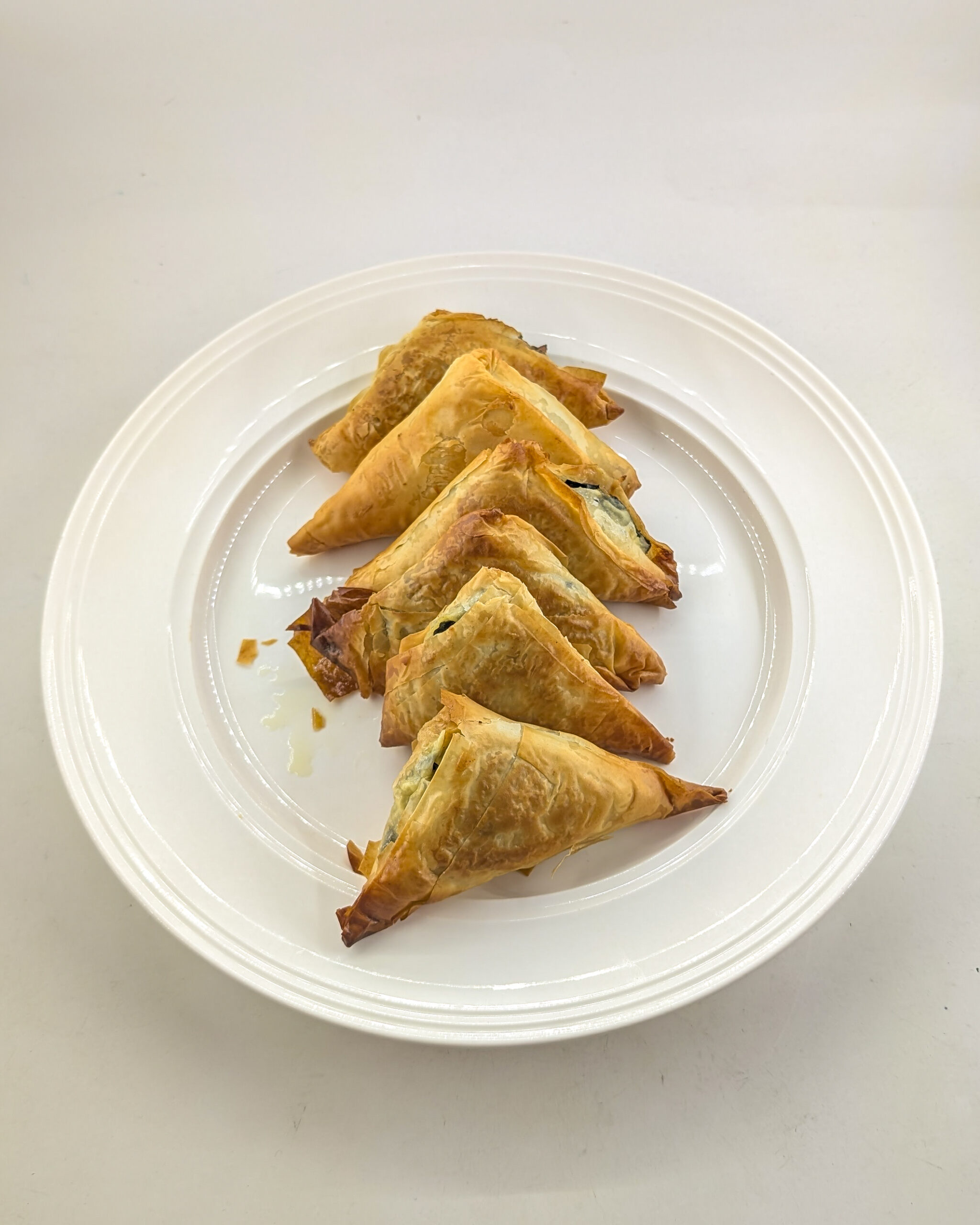
There is something undeniably addictive about the sound of biting into a freshly baked Spanakopita. That loud shatter of crispy pastry followed by the warm, savory filling is one of the world’s great culinary experiences. Whether you call it a spinach pie or a savory turnover, this Greek classic is a masterpiece of texture and flavor.
What is this dish?
Spanakopita is an iconic Greek savory pastry. The name literally translates to “spinach pie” (spanaki = spinach, pita = pie). It consists of a filling made from chopped spinach, feta cheese, onions, and seasonings, all wrapped in layer upon layer of paper-thin phyllo dough.
While it can be baked as one large “tray pie” and cut into squares, the version we are making today—and the one most popular at parties—is the hand-held triangle. Each triangle is individually folded, ensuring that every single bite has the perfect ratio of crispy crust to creamy filling.
How It Tastes
This dish is a celebration of savory contrasts.
- The Exterior: The phyllo dough, brushed with butter, bakes up into golden, flaky shards that are light and airy.
- The Interior: The filling is rich and earthy. The spinach provides a deep vegetable flavor, while the feta cheese adds a sharp, salty tang that keeps it from feeling too heavy.
- The Secret: A pinch of nutmeg. You might not identify it immediately, but it adds a warm, aromatic background note that ties the cheese and spinach together beautifully.
A Short Story of Its Origins
The roots of Spanakopita go deep into ancient history. The concept of wrapping filling in dough dates back to ancient Greece, but the specific technique of using thin, layered dough (phyllo) likely has influences from the Ottoman Empire.
For centuries, this was rural “peasant food.” It was practical: spinach and wild greens grew abundantly in the Greek countryside, and cheese was a staple. Wrapping these ingredients in dough created a portable lunch for farmers working in the fields who needed energy to get through the day.
Evolution From Past to Present
In the past, making Spanakopita was a labor of love. Home cooks would roll out their own dough until it was translucent—a skill that took years to master. The pies were often baked in large, round pans in communal village ovens.
As the dish moved into cities and eventually across the globe, convenience took over. The invention of machine-made frozen phyllo dough in the 20th century revolutionized the dish, allowing home cooks to make it in minutes rather than hours. The shape also evolved; while the large coil or tray pie is traditional for family dinners, the triangle shape became the standard for catering and street food.
Where It Stands Today
Today, Spanakopita is the most famous Greek dish outside of the gyro. You will find it everywhere: in high-end Mediterranean restaurants, in the frozen aisle of supermarkets, and at cocktail parties as a sophisticated finger food. It has transcended its rural roots to become a global comfort food that is vegetarian-friendly and crowd-pleasing.
Average Price Today
Spanakopita is generally quite affordable due to its humble ingredients.
- Bakeries/Cafes: A single large triangle or a slice of pie typically costs between $4.00 and $8.00 USD.
- Restaurants: As an appetizer plate (usually 3-4 smaller pieces), expect to pay $10.00 to $16.00 USD.
Recipe: Spanakopita (Greek Spinach Pie)
Origin: Greece
Serves: 2 Pax (Makes approx. 12 triangles)
Ingredients
The Filling:
- 800g Spinach, blanched and squeezed dry
- 80g Onion, chopped finely
- 80g Butter
- 150g Feta cheese, crumbled
- Pinch of Nutmeg powder
- Salt and Pepper (as needed)
The Pastry:
- Phyllo pastry sheets (as needed)
- Clarified butter (melted, for brushing)
Instructions
1. Sauté the Aromatics
Prepare your workplace. In a pan, melt the 80g of butter. Add the chopped onion and sauté until it is fragrant and soft.
2. Mix the Filling
Add the blanched spinach to the pan and stir to combine. Season with the nutmeg, salt, and pepper. (Be careful with the salt, as feta is naturally salty!). Remove from heat.
3. Cool and Crumble
Spread the spinach mixture on a tray to cool down. Once it is cool, mix in the crumbled feta cheese.
4. Prep the Pastry
Take one sheet of phyllo pastry and place it on your work surface with a long side near to you. Keep the remaining sheets covered with a damp cloth so they don’t dry out. Brush the sheet with melted clarified butter.
5. Layer
Place a second sheet of phyllo on top of the first one and brush with more butter.
6. Cut Strips
Cut the buttered phyllo stack crosswise into 6 strips. Each strip should be about 2 ¾ inches wide.
7. Fill and Fold
Place a teaspoon of the spinach-feta filling near the bottom corner of a strip. Fold the corner of the phyllo over the filling to form a triangle (like folding a flag).
8. Continue Folding
Continue folding the strip up, maintaining the triangle shape, until you reach the end of the strip.
9. Finish
Place the triangle seam-side down on a large baking sheet. Brush the top generously with butter. Repeat this process with the remaining phyllo and filling until you have used it all up.
10. Bake
Bake in a preheated oven at 180°C (350°F) for 20 to 25 minutes. The pastry should be a deep golden brown and very crispy. Serve warm!